






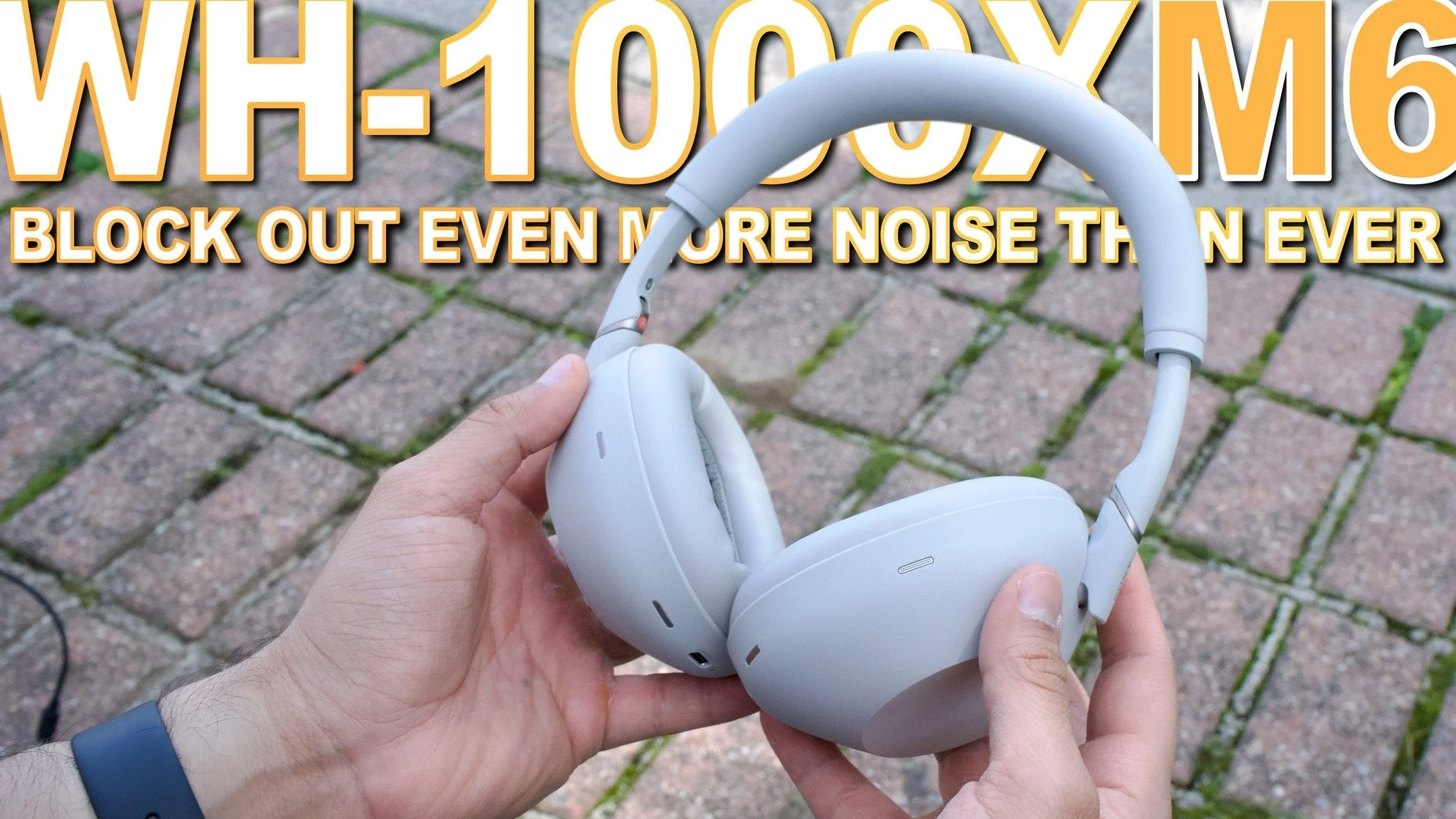
So right now, the Sony WH-1000XM6’s and the Sony WH-1000XM5’s have the best performing active noise cancelation on the market. And thanks to their atmospheric pressure sensors, their active noise cancelation is much more effective than the Active noise cancelation that you’ll find on other ANC headphones out there while at cruising altitude. However, Sony’s headphones might not be the most durable or the most luxurious thing out there. So today we’re going to compare them to the Bowers And Wilkins PX7 S3’s which look great and they sound great as well.
Regarding pricing, the Bowers And Wilkins PX7 S3’s have a retail price of $470, which is a lot but they are already going on sale for $430 and thanks to their build quality, id say therye worth it. Where as the Sony 1000XM6’s have a retail price of $450 and the XM5’s have a retail price of $400 but these can be found on sale now as well. So if you want to pick any of these headphones up they’ll be linked down below or you can always press on the YouTube shopping button, and if you want to further support the channel then you can always watch some of the related videos in the description below.
So first lets talk about these cases, since the PX7 S3’s have a lay flat design to them, their case does have a larger foot print to it, however I still feel that this case is manageable if you plan on traveling with these headphones. Where as with the XM5’s, these headphones also only have a lay flat deign to them, but this case is noticeably larger… and even though the ANC on the XM5’s is very good, for me its very hard to justify traveling with these headphones cause their case is just way to big. Where as with the Sony 1000XM6’s, since these eahdphoens have a fully collapsible design to them, their case is smaller and much more manageable. Now yes, the PX7 S3’s case does feel more premium and durable, but the XM6’s case is good enough.
But with the cases out of the way, lets talk about the headphones themselves. Now with all of these headphones, these ear cups pivot and swivel a good amount so they are going to be able to rest naturally on your head, all of these headbands glide in and out but like I’ve said before, I prefer when my headbands click cause its just easier to find your fit. However, the gliding action on the PX7 S3’s just feels much sturdier than these other two headphones, especially the XM5. And overall, the PX7 S3’s just have much better build quality and therye using much more premium materials. With both of Sony’s headphones they are using recycled plastics and the leatherette on these headphones feel like soft touch silicon but with less grip to it. Where as the PX7 S3’s, these have real leather that get softer over time, a lot of their surface areas are covered in fabric and the headband arms are machined metal, which not only look good, they’re also more durable, cause Sony’s headphones do have a reputation of breaking at the hinges.
However when it comes to fit, the PX7 S3’s fit okay but they might not be for everyone. For starters when it comes to clamping force, the PX7 S3’s can be a little on the tighter side even after being broken in, so to be safe, I wouldn’t say that these are big head approved. Where as with both of Sony’s headphones, both of these headphones have less clamping force and they are big head approved, but they have a neutral amount of clamping force, if you’re looking for something with a looser fit then you still want to go with Bose’s headphones. But then there’s the headband on these headphones, one of my biggest issues with the XM5’s is that their headband is very small and it has very little padding, so for me, hot spots can be an issue with these headphones. Where as with the XM6’s this headband has a larger surface area and it has more padding so hot spots aren’t as big of an issue. And the PX7 S3’s headband has even more surface area… but its padding is a little stiffer. But then there are the ear pads on these headphones. Now the earpads on the XM5’s have a large diameter to them, but they can be a little shallow for people with average sized ears, where as with the XM6’s these earpads are a little deeper so they are a little more spacious, but then there are the PX7 S3’s which are even more spacious than the XM6’s… however with the PX7 S3’s since these have more padding coming in contact with your skin, these ear pads can heat up faster Sony’s ear pads.
And finally there’s their weight, the Bowers And Wilkins PX7 S3’s weigh in at 300 grams, which isn’t bad especially given their improved build quality and materials… but Sony’s headphones are much lighter by comparison, the XM6’s weigh in at 254 grams and the XM5’s weigh in at 250 grams. So with both of Sony’s headphones, these are just a lot less noticeable when you’re walking around with them on and they are much easer to forget that you’re wearing them when youre sitting with them at your desk, which in bed or while you’re flying with these headphones.
So overall, the Bowers and wilkins PX7 S3’s have improved build quality and they are using more premium materials than both of Sony’s headphones, and looks wise, I think the PX7 S3’s look great, where as the XM6’s have a more subtle design to them and the XM5 do look pretty bulbs. However the PX7 S3’s aren’t as comfortable as the XM6’s cause they do weigh noticeably more, they have a tighter fit to them and their ear pads can get warmer much faster. I think the PX7 S3’s are going to be better suited for someone with a smaller head where as the XM6’s will be able to fit more people, better.
But now lets talk about tech specs, when it comes to battery life, all of these headphones have an advertised battery life of 30 hours with their ANC turned on, which is a little above average, and you can always extend their battery life by using them with their ANC tuned off.
All of these headphones also charge via a USB C port as they should… but with the PX7 S3’s you can also use this USB C port as a wired connection if you want, making them a good option if you want to game with these headphones, but with both the PX7 S3 and XM6 you can use them while they are charging as well.
Now with all of these headphones you can also use them with an audio jack connection, but with the PX7 S3’s you have to use them with their USB C to audio jack cable… where as both of Sony’s headphones have your standard audio jack and you can also use them passively, which I feel is a big deal for travelers or for content creators. Where as with the PX7 S3’s even if you want to use them with a wired connection, they have to be powered on.
But when it comes to bluetooth connectivity, both of these headphones can be connected to any two bluetooth devices at the same, making them a great option for any power user out there that likes to hot swap between lets say your PC and iPhone… and latency is not an issue for any of these headphones so you can use them to watch videos with on your phone. And when it comes to audio codecs, all of these headphones have support for SBC and AAC, duh, but the Sony’s have support for LDAC which is sony high res audio codec where as the PX7 S3’s have support for APTX Classic, HD, Adaptive, and Lossless… but in order to use any of these higher quality audio codecs you do have to be an android user cause iPhones top out at AAC, but regardless all of these headphones sound good with AAC.
But now lets talk about actually lisnteing to music with these headphones. And well, I feel that the Bowers And Wilkins PX7 S3’s sound like an improved version of the Sony 1000XM6’s but with more resonance and kick in their bass. Ever since the Sony 1000XM5’s came out, sony has been trying to improve the instrument separation on their headphones… So both the XM5 and XM6 sound more open than Sony’s mid tier and older headphones. But what the XM5 and XM6 have been lacking is resonance in their bass. Where as with the PX7 S3, these also have great instrument separation and they have very good detail in the highs, but with these, they also have a lot more resonance in their bass, and if you’re someone that likes a lot of kick in their bass, then the PX7 S3 can deliver on that better than Sony’s headphones cause these can have more kick in their bass. So I think all of these headphones are going to be people pleasers for the most part, but with the PX7 S3’s you are going to get a richer listening experience cause the bass on these headphones just comes in harder than Sony’s headphones.
Now when it comes to the media controls on these headphones, both of Sony’s headphones have the same touch pads, they work well and they are easy enough to use, so you can swip front or back to skip through your music and you can swipe up and down to adjust your volume… but with the PX7 S3’s these are just using physical buttons, so these buttons just work… and having these physical buttons lends themselves to the overall design langue of these headphones.
However, all of these headphones still have wear sensors, so whenever you take these headphones off they’ll automatically pause your music and when you put them back on, they’ll start playing your music again. Now personally I don’t care for wear sensors on my headphones, so I just usually turn them off, but they are there if you want them.
Now when it comes to the active noise cancelation on these headphones… well I just hope that active noise cancelation isn’t very important to you cause the ANC on the PX7 S3’s performs like the ANC that you’ll find on a pair of mid tier ANC headphones. Not premium ANC headphones like these are priced at. But so that you can see for yourself we’re going to jump into an ANC test.
ANC Test
So like you may have just seen, both the Sony 1000XM6 and Sony 1000XM5 block out way more noise than the PX7 S3’s. Its not even close. The ANC on the PX7 S3 is more like a pair of mid teir ANC headphones like lets say the Sony ULT Wear. The ANC on the PX7 S3 is going to be useful on a bass ride commute cause they block out some lower frequency sounds like road noise, but they really struggle when it comes to blocking out chatter. But then there’s also the atmosprhic pressure sensors on Sony’s headphones which will allow these headphones to block out way more noise than the PX7 S3’s while at cruising altitude. So plainly said, if active noise cancellation is very important to you, or if you plan on flying a lot with your headphones, then you simply want to go with Sony’s headphones. And yes, the Sony 1000XM6’s do block out noticeably more noise than the Sony 1000XM5’s.
And then there’s the ambient mode on these headphone, now the ambient mode on the PX7 S3 sounds good enough to get the job done… but the ambient mode on both of Sony;s headphones sounds more natural, any more importantly, their microphone arrays do a better job of rejecting wind noise when walking out doors. But also Sony’s ambient mode does have a few other features over the PX7 S3’s, for starters both of these sony headphones have Speak to chat which works like this.
Speak to chat demo
But personally, I’m not a really big fan of speak to chat because it is very easy to accidentally active it. If you’re talking to yourself very quietly that can activate it, if you’re singing along to your music, that can activate it, if you start laughing that can active it, and on rare occasions loud enough outside noises can activate it. So that’s why I don’t use it.
Personally, I still prefer to use quick attention on these headphones cause its a lot more intentional. When you fully cover the touch pad on these headphones they’re going to lower the volume of your music and pump in all of the ambient sound around you like this.
Quick attention demo
And then when you let go, the headphones will go back to normal. Now like I said, I prefer quick attention cause its a lot more intentional. And this feature is extremely useful especially when you’re flying with these headphones. But I still feel that sony should change it so that when you have this touchpad covered for 5 seconds or more, they should lock themselves in this state so that you can let go, cause keeping your arm up can get uncomftabel and award after awhile. And this is something that they can change through a software update.
But regardless, im glad that sony has this feature cause this is something the PX7 S3’s simply don’t have, and this is a pretty standard feature on premium and mid tier ANC headphones…
Mic XM6 Quiet
But finally here’s the microphone test, now even though I really like the Sony 1000XM6’s and these are the best headphones to fly with cause they block out the most amount of noise… their microphone needs work.
Mic XM5 Quiet
Now the mic on both the Sony 1000XM6’s and Sony 1000XM5’s are good enough to take phone calls with while in a quiet room, but I am actually suprusied that the Mic on the Sony 1000XM5’s out performs the Mix on the Sony 1000XM6.
Mic PX7 S3 Quiet
Now the mic on the Bowers And Wilkins PX7 S3 also sounds good while in a quiet room, and I would say that this mic performs better than the Mic on the Sony 1000XM6.
Mic PX7 S3 Road
Cause when it comes to blocking out noise pollution, the Bowers And Wilkins PX7 S3’s are doing a good job of reducing all of this road noise
Mic XM5 Road
However, the Sony 1000XM5’s are doing an even better job of reducing all of this road noise, cause for comparison sake, if we were to switch over to my lapel micrponhe, you’re going to clealery hear all of this road noise, but if we were to switch back over to the Sony 1000XM5’s it is severely reduced. And personally I am surprised that the Sony XM5’s out perform the Sony XM6 here.
Mic XM6 Road
Cause with the Sony 1000XM6’s, even though they have 6 beam forming mics, versus the 4 beam forming mics found on the XM5’s, these do struggle when it comes to blocking out noise pollution, and I feel the PX7 S3’s do a better job than the Sony XM6.
Mic XM6 Chatter
And its the same thing when it comes to blocking out chatter, these are just letting in a lot of noise pollution and there’s a lot of interference going on with my voice.
Mix PX7 S3 Chatter
Where as with the Bowers And Wilkins PX7 S3’s, these are doing a better job of dealing with all of this noise pollution with less interference going on with my voice when compared to the Sony 1000XM6.
Mix XM5 Chatter
And finally here are the Sony WH-1000XM5’s which I feel are doing the best job here of dealing with all of this noise pollution, cause again for comparison sake, if we were to switch over to my lapel microphone, you’re going to clealery hear all of this chatter, but if we were to switch back over to the Sony 1000XM5’s it is severely reduced. So overall, the mic on the Bowers And Wilkins PX7 S3 is surprisingly good, but the mic on the Sony 1000XM5 is better, and I feel the mix on the Sony 1000XM6 still needs work, and that’s very surprising to me.
But with all of that being said, both the Sony 1000XM6 and Sony 1000XM5 are going to offer you much better active noise cancellation, a better sounding ambient mode, more features, and they are more comfortable than the Bowers And Wilkins PX7 S3’s cause they are lighter and they have less clamping force. Simply put, if you plan on flying a lot with your headphones, then the Sony 1000XM6 are the way to go cause they block out the most amount of noise, plus they also have a smaller case. Now the Sony 1000XM5’s also block out more noise than the PX7 S3’s… but their case is pretty big. But where the PX7 S3’s stand out here is they do have better build quality and they are using finer materials than Sony’s headphones, the PX7 S3’s are meant to last and they stand out. They also sound a little better than Sony’s headphones cause they have more bass.