
⚡️🔋 Anker Prime Base: https://geni.us/GC-AnkerPrimeBase
Sony ULT Tower 5: https://geni.us/GC-SonyULTTower5
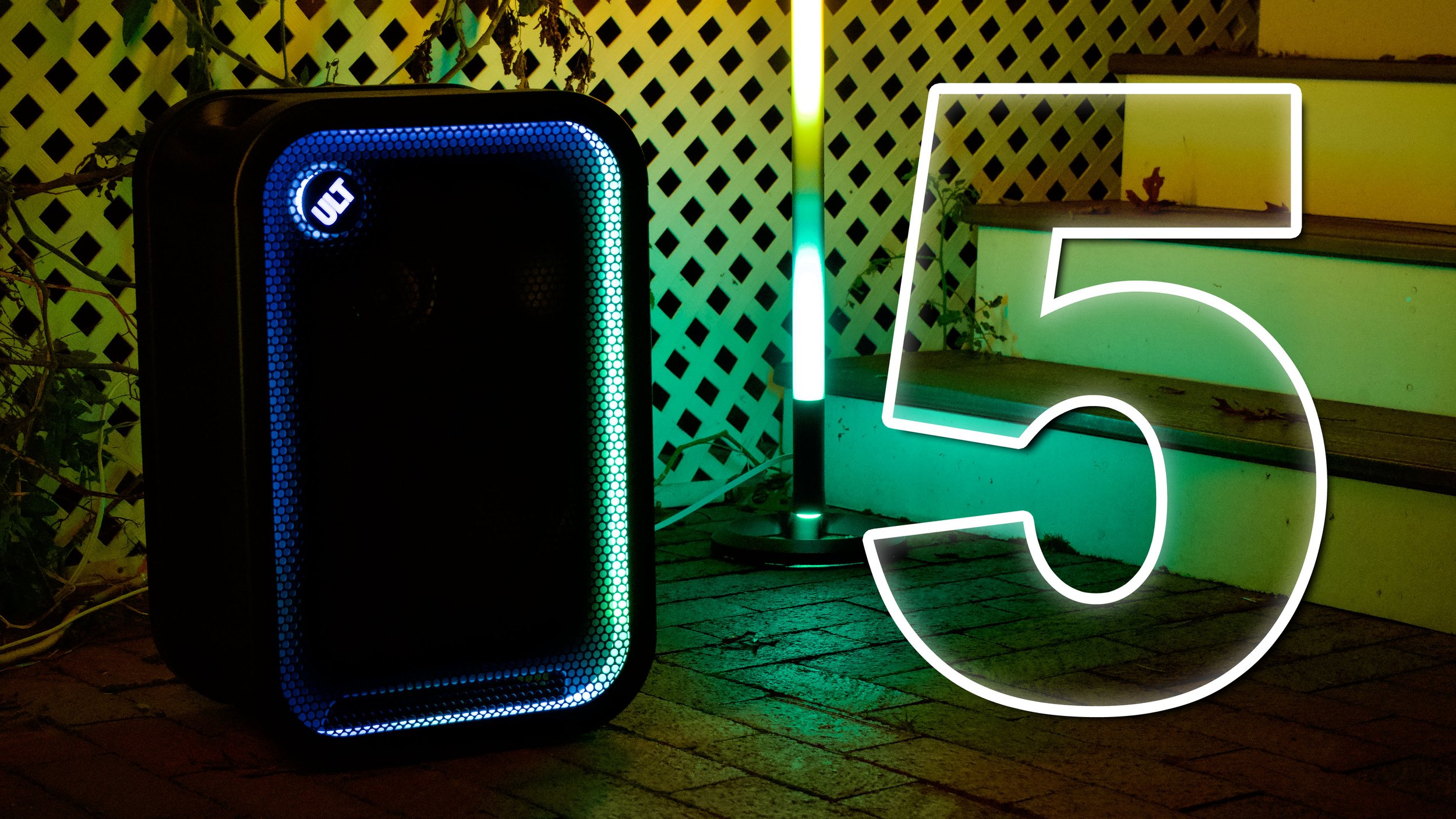
A Massive Generational Leap: Sony ULT Tower 5 Review (vs Sony XV500 & ULT Tower 7)
If you have been keeping up with the portable party speaker market, you already know that the larger Sony ULT Tower 7 ($650) is an absolute powerhouse thanks to its dedicated mid-range drivers and room-shaking output. Right below it sits its more affordable, grab-and-go sibling: the Sony ULT Tower 5.
While the ULT Tower 5 omits the dedicated mid-range drivers found on the pricier ULT Tower 7, it brings a massive generational overhaul to Sony’s compact party lineup—specifically serving as a major upgrade over the older Sony SRS-XV500. For years, the biggest flaw holding back the XV500 was its anemic volume output when unplugged from the wall. With the new ULT Tower 5, Sony didn't just fix that battery bottleneck—they re-engineered the bass architecture,upgraded the wireless pairing protocol, and outfitted the rear panel with professional DJ inputs.
To see if it belongs at your next gathering, we put the Sony ULT Tower 5 head-to-head against the outgoing Sony XV500 (while comparing how it scales against the larger ULT Tower 7 and competitors like the JBL PartyBox 130 and 120) across build quality, battery life, pro-versus-consumer connectivity, and real-world sound performance.
Quick Specs & Pricing Overview
Sony ULT Tower 5 ($450): The mid-sized sweet spot in Sony's new ULT lineup. Weighs 28 lbs with a 2-way acoustic setup (1 front-firing woofer with a downward-firing bass exhaust port and dual front-firing tweeters), up to 20 hours of battery life, a DIY swappable battery, IPX4 splash resistance, pro-grade XLR and RCA inputs/outputs,and fast Auracast wireless pairing.
Sony SRS-XV500 (Previous Generation): The outgoing model. Features a lighter cabinet with dual front-firing woofers, a front-firing bass port, dual front tweeters, dual quarter-inch mic inputs, a 3.5mm Aux jack, and a universal double-barrel AC power port, but suffers from severely throttled volume when running on internal battery power.
Sony ULT Tower 7 ($650): The step-up sibling. Upgrades to a 50-lb cabinet with built-in wheels, a 3-way acoustic architecture (adding dual mid-range drivers and four total tweeters), dual internal batteries for up to 30 hours of playtime, and higher maximum volume output.
1. Design, Portability, and Durability
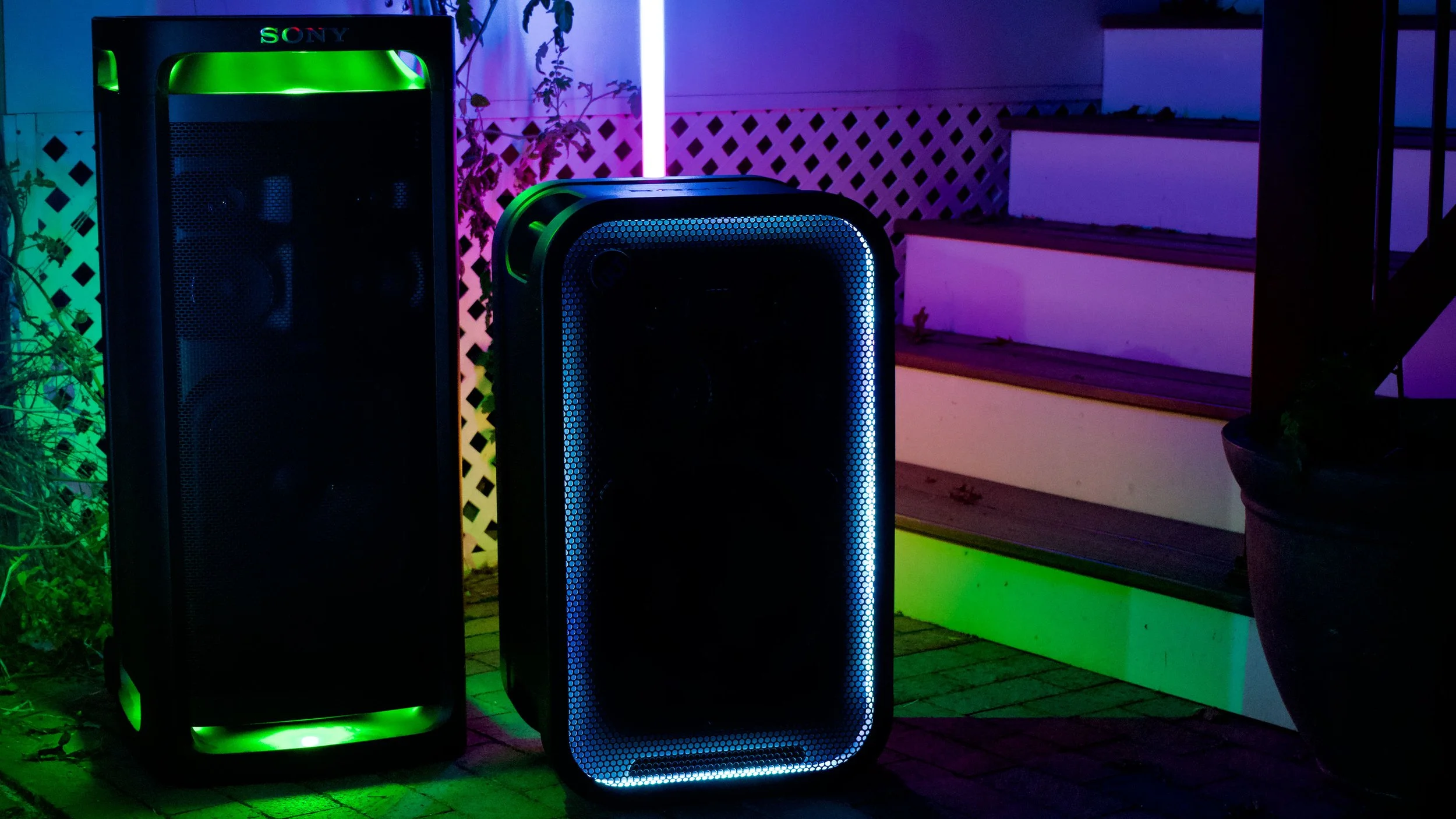
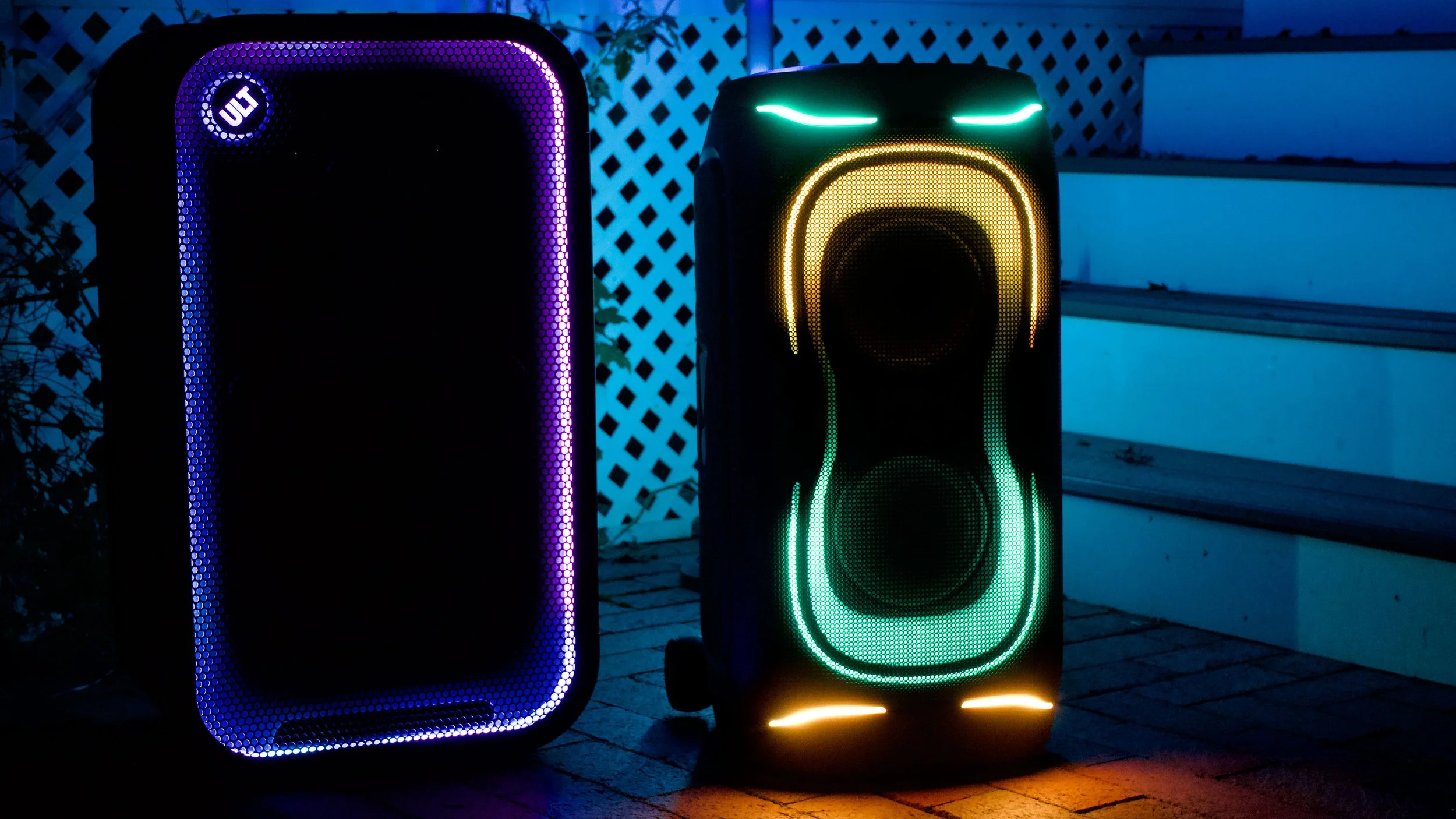
Compared to both the older Sony XV500 and direct rivals like the JBL PartyBox 130 and JBL PartyBox 120, the Sony ULT Tower 5 has grown noticeably larger and heavier:
Weight & Portability: Weighing in at 28 pounds, the ULT Tower 5 is still small and light enough for one person to pick up and carry around. However, at nearly 30 pounds, it is right on the borderline where Sony really should have included built-in bottom wheels and a telescopic luggage handle to make long-distance hauling effortless.
Durability & Weatherproofing: The extra weight isn't wasted—just like the larger ULT Tower 7, the plastic enclosure and front grille on the ULT Tower 5 feel substantially denser and more rugged than the competition. While it isn't built like an indestructible touring rig (such as a SOUNDBOKS), it can easily handle bumps and rough handling at tailgates or backyard gigs. It also carries an IPX4 water-resistance rating, meaning splashes and light rain are never an issue as long as the rear port cover is sealed shut.
Upgraded Party Lighting: While Sony's lighting effects still aren't as flashy or full-bodied as JBL's PartyBox light shows, the new LED arrangement on the ULT Tower 5 is a noticeable visual upgrade over older Sony speakers.Using the companion app, you can cycle through multiple lighting presets or customize the colors to match your vibe.
2. Battery Life, Unplugged Output, and Swappable Packs
If you ever owned or tested the older Sony XV500, you know its biggest Achilles' heel was its battery performance—and this is where the Sony ULT Tower 5 delivers its single biggest upgrade:
Full Unplugged Volume (The XV500 Fix): When you unplug the older Sony XV500 from the wall, its internal amplifier throttles back drastically; max volume (100%) on an unplugged XV500 only sounds as loud as the new ULT Tower 5 playing at roughly 70% volume. To get respectable volume out of the XV500, you essentially had to keep it tethered to a wall outlet. The Sony ULT Tower 5 completely fixes this, delivering the loud, punchy output you expect even when running strictly on battery power.
Real-World Playtime: Sony rates the ULT Tower 5 for up to 20 hours of battery life at 30% volume with the ULT bass mode turned on and the lights turned off (a great level for casual indoor listening). Turning the party lights on brings rated playtime to roughly 12 hours, while pushing the speaker at 100% maximum volume yields around 2 hours of continuous playback.
Affordable DIY Battery Replacement: Like the larger ULT Tower 7, the ULT Tower 5 features a replaceable battery that protects your investment years down the road. While you do need a screwdriver to open the battery bay,the Tower 5 uses a single off-the-shelf battery pack (the exact same battery that the ULT Tower 7 uses in a dual-pack setup). Because Sony doesn't lock you into expensive, proprietary branded batteries, you can easily find affordable replacement cells online.
AC Wall Boost & Power Cable Changes: Plugging either the ULT Tower 5 or the XV500 into a wall outlet unlocks an extra headroom boost in both peak volume and low-end bass. However, while the older XV500 used a universal double-barrel AC power cord (the same ubiquitous cable used by a PlayStation 5), Sony switched the ULT Tower 5 over to a proprietary square power connector—so be careful not to lose the included cord.
3. Connectivity, Pro DJ Ports, and Karaoke Features
On the wireless side, the Sony ULT Tower 5 checks every modern box: it supports Bluetooth multipoint (letting two phones stay connected to play DJ simultaneously), exhibits zero noticeable video latency when watching movies on your phone, and supports Sony's high-resolution LDAC codec on Android devices (while iPhones top out at standard AAC,and enabling LDAC will drain the battery faster).
Look at the physical port panel on the back, however, and Sony made a controversial pivot away from everyday consumers toward gigging pros and DJs:
Missing Consumer Ports: Frustratingly, Sony removed the standard 3.5mm Aux-In jack, the 3.5mm Aux-Out jack,and the optical audio input—a feature JBL actually copied from Sony so users could easily hook their party speaker up to a TV with zero latency. If you want to plug a standard 3.5mm audio cable into the ULT Tower 5, you will need to buy an inexpensive 3.5mm-to-RCA adapter.
Pro-Grade XLR & RCA Inputs/Outputs: In place of consumer jacks, Sony outfitted the ULT Tower 5 with stereo RCA Line-In, a dedicated XLR Input, and an XLR Line-Out. If you are a DJ or musician running an external mixer, this is a massive upgrade that lets you plug straight into the speaker and daisy-chain additional active speakers via XLR. (Note: The XLR ports do not provide phantom/bus power, so XLR microphones still require an external mixer).
Microphone Inputs & Vocal Removal: While the older Sony XV500 (and most rival party speakers) included two quarter-inch inputs for dual microphones, Sony downgraded the ULT Tower 5 to a single quarter-inch mic input. If you want to run two microphones for karaoke duets on the Tower 5 (or Tower 7), you will either need to buy a dual wireless microphone system or run your mics through an external mixer. On the bright side, Sony's companion app includes key/pitch shifting, vocal echo (great for masking off-key singing), and a built-in two-level Vocal Removal tool that strips vocals out of standard tracks for instant karaoke.
4. Acoustic Architecture & Head-to-Head Sound Test
Tested side-by-side at 75% volume across all ULT bass modes (testing the XV500 both plugged in and on battery power),the internal acoustic redesign inside the ULT Tower 5 immediately separates it from its predecessor:
Downward-Firing Bass Exhaust Architecture: The older Sony XV500 used a conventional layout with dual front-firing woofers, dual front tweeters, and a front-firing bass exhaust port. For the ULT Tower 5, Sony switched to a single large front-firing woofer, dual front-firing tweeters, and a downward-firing bass exhaust port that couples directly with the floor. It also includes Sony's signature ULT button: ULT 1 delivers deep, rounded sub-bass ideal for indoor rooms, while ULT 2 boosts both bass punch and overall sound pressure for outdoor spaces.
Bass Impact & Midrange Balance: On the older XV500, the bass was mostly audible rather than physical. Thanks to the downward-firing exhaust port on the ULT Tower 5, you get a serious, chest-thumping kick in the low end.Better yet, the bass remains tight, clean, and well-defined—it never bleeds into or muddies the rest of your music,giving the Tower 5 a noticeably fuller and more balanced sound signature than the XV500.
Max Volume & Party Size: Unplugged or plugged in, the Sony ULT Tower 5 easily fills a 15-to-20-person partywith rich, energetic sound. While the XV500 has to be plugged into an AC outlet just to keep pace with an unplugged ULT Tower 5, plugging the ULT Tower 5 into the wall pushes its max volume and bass depth into another tier entirely.
5. Multi-Speaker Pairing & The Auracast Ecosystem
If you purchase two Sony ULT Tower 5 speakers, you can wirelessly link them as a dedicated Left and Right stereo pair.If you want to link different speakers together for a massive party setup, the ULT Tower 5 transitions to Sony's newest wireless architecture:
Next-Gen Sony Auracast: The ULT Tower 5 uses Auracast, allowing it to pair almost instantaneously with Sony's new-generation speakers—specifically the ULT Tower 7 and ULT Tower Max. The handshake is remarkably fast,and wireless stability remains rock-solid even in environments crowded with other wireless gear.
Walled Gardens & Backward Compatibility: Although Sony states they are using an open-source implementation of Auracast, competing brands like JBL and Soundcore lock their Auracast speakers inside walled gardens—meaning you cannot wirelessly pair a Sony ULT Tower 5 to a JBL PartyBox. Furthermore, while Sony claims the new ULT Tower 5, Tower 7, and Tower Max are backward-compatible with older Sony Wireless Party Chain speakers (like the ULT Field 5 or ULT Field 7), they refused to connect even on the latest firmware during testing—suggesting Sony still needs to push a future firmware patch to bridge the generations.
Should You Buy the Sony ULT Tower 5?
Buy the Sony ULT Tower 5 ($450) if you want the best-sounding mid-sized party speaker in its price bracket. It completely solves the unplugged volume weakness of the older XV500, delivers deep, clean, floor-coupling bass that never muddies the vocals, features an easily replaceable battery, and gives DJs pro-level XLR and RCA connectivity.
Step up to the Sony ULT Tower 7 ($650) if you are hosting larger 20-to-30-person parties and want dedicated mid-range drivers and four tweeters for true 3-way instrument separation and even higher peak volume.
Look at the JBL PartyBox 130 or 120 only if you prioritize consumer-friendly plug-and-play features—like dual quarter-inch mic inputs, a 3.5mm Aux jack, lighter portability, or a flashier full-cabinet RGB light show—over Sony's superior acoustic balance and XLR pro inputs.
Frequently Asked Questions (FAQ)
Is the Sony ULT Tower 5 a big upgrade over the Sony XV500?
Yes. The biggest flaw with the older Sony SRS-XV500 was that its maximum volume dropped drastically when unplugged from wall power. The Sony ULT Tower 5 fixes this completely, delivering powerful, loud output on battery power while adding a downward-firing bass exhaust port for much deeper, cleaner bass, a user-replaceable battery, XLR inputs/outputs, and Auracast wireless pairing.
How does the Sony ULT Tower 5 compare to the Sony ULT Tower 7?
The Sony ULT Tower 5 ($450) is more compact at 28 pounds and uses a 2-way driver system (single woofer with downward exhaust and dual tweeters) ideal for 15-to-20-person gatherings. The larger Sony ULT Tower 7 ($650) weighs 50 pounds, adds built-in wheels, doubles the battery pack for up to 30 hours of playtime, and upgrades to a 3-way acoustic layout with dedicated mid-range drivers and four tweeters for superior vocal separation and louder output.
Can I connect the Sony ULT Tower 5 to my TV or plug in two wired microphones?
Unlike the older XV500, Sony removed the optical TV input and 3.5mm Aux jacks on the ULT Tower 5, and reduced the microphone inputs to a single quarter-inch jack. However, it features stereo RCA inputs and XLR In/Out ports, meaning you can easily connect an external mixer to run multiple microphones or use an RCA-to-3.5mm adapter for wired audio sources.
Is the battery on the Sony ULT Tower 5 replaceable?
Yes. By removing a few screws on the battery compartment, you can swap out the internal battery. It uses a single standard, off-the-shelf battery pack (the exact same battery model used as a dual-pack inside the ULT Tower 7), making long-term battery replacements affordable and easy to source online.
Can the Sony ULT Tower 5 pair with JBL Auracast speakers or older Sony speakers?
No. While the ULT Tower 5 pairs rapidly via Auracast with the new Sony ULT Tower 7 and ULT Tower Max, other brands like JBL and Soundcore wall-garden their Auracast implementations, preventing cross-brand pairing. Additionally, backward compatibility with older Sony Party Chain speakers (like the ULT Field 5 and Field 7) did not work during testing on current firmware.
I really like the Sony ULT Tower 7, this speaker gets very loud but more importantly, this is a great sounding speaker. But we also have the Sony ULT Tower 5, now the Sony ULT Tower 5 doesn’t have mid range drivers like the Sony ULT Tower 7, which makes this speaker very special… however the Sony ULT Tower 5 also sounds very good and most importantly, this speaker is a huge upgrade over the Sony XV500. So today lets check out the Sony ULT Tower 5 and lets see if its right for you.
Regarding pricing, the Sony ULT Tower 5 has a retail price of $450, and for comparison sake, the Sony ULT Tower 7 has a retail price of $650. But knowing sony I do expect these speakers to go on sale on a regular basis. So if you want to pick these speakers up they’ll be linked down below or you can always press on the YouTube shopping button, and if you want to further support the channel then you can always watch some of the related videos in the description below.
So first there’s the design of this speaker, now I will admit, the Sony ULT Tower 5 is pretty big and pretty heavy when compared to the Sony XV500. The Sony ULT Tower 5 weighs in at 28 pounds, which is up there, and the Sony Tower 5 is larger and heavier than its most direct competitors, the JBL Partybox 130 and JBL Partybox 120. But still, the Sony Tower 5 is still small and light enough to carry around. However I think it would have been super clutch is Sony included wheel and a telescopic handle on this speaker so that you could roll it around.
Now Sony’s new ULT Tower 7 and ULT Tower 5 are big and heavy when compared to the rest of the competition… however these speakers do feel more durable… now they’re not as rugged as lets say a SOUNDBOKS… but if you do plan on being a little rough with your speaker, then the Sony ULT Tower 5 should be able to keep up within reason. Plus the ULT Tower 5 isn’t afraid of some water thanks to its IPX4 rating, just as long as you have the port panel on the back closed.
But then theres the list feature on this speaker, now Sony’s light features aren’t as dynamic as JBL’s light features… however this new light feature on the Sony ULT Tower 5 does look better and its more impressive than Sony’s older speakers. And though Sony’s app you can go in and choose from a few different lighting modes and you can also customize this light feature if you want. So like I said, this light feature isn’t as dynamic as router light features out there, but it is better. And besides, these speakers really shine when it comes to sound quality.
Now when it comes to battery life, this is a major upgrade over the Sony XV500… this was actually the biggest issue with the Sony XV500. The Sony ULT Tower 5 has an advertised battery life of 20 hours and that’s with this speaker playing at 30% volume which is a decent volume for when you’re around the house, but that with the light feature turned off but with the ULT Feature turned on, which is good. And if you were to use this speaker with the lights turned on then its going to have an advertised battery life of 12 hours. And at max volume is good for around 2 hours of playback time.
But the main fix here is… the Sony ULT Tower 5 sounds as loud as you’d expect it when its running off of its internal battery. Where as with the Sony XV500… this speaker is very quite when its running off of its internal battery. With the Sony XV500 playing at max volume… that’s like the Sony ULT Tower 5 playing at 70% volume. So with the Sony XV500 you would have to use it while its plugged in, cause it honestly sounds very dissapoitning when its running off of its battery… but that’s not longer an issue for the Tower 5.
And something that is new for the Tower 5 is that you can swap out the battery if you need to. However in order to get to this battery, you are going to have to use a screw driver… but the important thing is, you can swap out this battery if you need to which is going to be good for the overall live of your investment. Now the tower 5 is using the same off the shelf battery as the Sony ULT Tower 7, however its only using one instead of two… but swapping out your battery should be affordable cause you can easily find these batteries online, and since sony isn’t trying to sell you Sony Branded batteries, you aren’t going to get over charged.
Now when it comes to charging these speakers, there are some changes here. The Sony XV500 charges via a super common double barrel AC port, and I prefer this cable cause its very common, this is the same cable that you get with your PlayStation 5. Where as the Sony ULT Tower 5 is now using a square port, which means a new cable which isn’t as common, so you’ll want to be mindful of where you store this cable. However with both of these speakers if you use them while they are plugged in you are going to get a performance boost out of them, they are both going to get louder and they are both going to have more bass.
But now lets talk about connectivity, cause there’s a lot going on here, some good and some things that I still don’t like. For starters, the Sony ULT Tower 5 can be connected to 2 devices at the same time so you and a friend can both be DJ. Latency is not an issue for this speaker so you can use it to watch movies with on your phone. And it has LDAC support, but it can only be used with an Android device cause iPhones top out at AAC and LDAC does take an additional toll on the battery life.
Now when it comes to the ports on this speaker, Sony is focusing more on the pros here than on the general consumer, cause unfortunately the tower 5 doesn’t have an audio jack, it doesn’t have an audio out jack and sadly, Sony removed the optical port on this speaker which I feel is a huge mistake cause this is something that JBL copied from Sony on their new speakers, and that optical port is very useful when it comes to latency if you want to hook this speaker up to your tv.
However, the Sony ULT Tower 5 does have an RCA and XLR Line in and it has an XLR line out… which can be super useful for people that want to DJ with these speakers and use them with a mixer plus you can daisy other speakers to this speaker via the XLR Line out. And if you really want to use an audio jack connection then you can always get an adaptor for the RCA line in. Just keep in mind that these XLR ports don’t have bus power, so you want be able to power a microphone.
However you can plug in a wired mic via the 3 quarter inch input… but unfortunately the Tower 5 only has one three quarter inch input where as the Sony XV500 has 2 inputs and the majority of other speaker also have 2 inputs… so I think Sony downgrading to 1 mic input is a set back.
So now, if you want to use more than only mic with Sony’s speakers, you’re going to have to get a pair of wireless speakers. Or you can always get a mixer as well. Now through Sony’s app you can adjust the pitch of your music, you can mic it sound brighter or warmer… now personally I’m not a big fan of this specific feature… but its there if you want it. But more importantly you can go in an add an echo which can help hide how off key you are. But still you can’t adjust the sound of your microphone like you can with other speakers out there.
But something that is also new for this speaker is that it now has a vocal removal tool. Now you do have two levels to this vocal removal tool… now its not the best vocal removal tool, but its there and it gets the job done. So if you’re planing on doing lots of kakroke… the Sony ULT Tower 7 is an okay option cause it does come included with a Vocal removal tool… but I do think that its a shame that now if you want to use more than one microphone with this speaker you’re either going to have to get a wireless microphone system or you’re going to have to get a mixer. The Sony ULT Tower 7 is a consumer speaker… but it kind of looks like Sony is leaning more towards professionals that are more likely to use these speakers with a mixer.
But with all of that being said, lets talk about sound. When it comes to speaker setups the Sony XV500 has your typical set up of dual frontward firing woofers with and exhaust port that shoots out the front and it has dual frontward firing tweeters. Where as with the Sony ULT Tower 5, this speaker has a single frontward firing woofer with an exhaust port that shoots out the bottom and it has dual frontward firing tweeters. The Sony ULT Tower 5 also has your ULT button. ULT 1 is going to give you more bass so this is the setting that I would recommend while indoors and ULT 2 is going to give you more bass and more sound pressure, so this is the setting that I would recommend while out doors. But now we’re going to jump into the soundtest, both of these speakers are playing at 75% volume and were going to be switching between the different ULT modes… but with the Sony XV500 we’re also going to use it while unplugged so that you can understand the battery performance of this speaker.
Sound test
So first we need to talk about the max volume performance… like you may have just seen, so that the Sony XV500 can keep up with the Sony ULT Tower 5… it has to be plugged in. Otherwise the max volume performance of the Sony XV500 is disappointing when its running off of its internal battery. But thankfully that’s not that case for the Sony ULT Tower 5. And when it comes to the max volume performance, the Sony ULT Tower 5 is good for a 15 to 20 person party and just like the Sony XV500, if you were to use the Sony ULT Tower 5 when it’s plugged in, you are going to get a performance boost out of it, its going to get louder and its going to have more bass.
But when it comes to sound quality, the Sony ULT Tower 5 manages to sound more balanced and fuller than the Sony XV500. Thanks to the downward firing exhaust port, the Sony ULT Tower 5 actually now has a good amount of kick to its bass, where as the bass on the sony XV500 was more on the audible side. But also thanks to the downward firing exhaust port, the Sony ULT Tower 5 not only has more kick in its bass… the bass is also clean and well defined and more importantly it doesn’t muddy the rest of your music. Overall, Sony did an exelecnt job of fixing the Sony XV500’s main problem and that was the volume performance when its running off of its internal battery. Cause with the Tower 5, this speaker gets as loud as you’d expect it when it running off of its battery, but also this speaker sounds better cause it sounds more balanced and it has more kick in its bass.
But finally lets talk about pairing this speaker up with other speakers. Now for starters, the Tower 5 is now using aura cast… and this speaker pairs up with other speakers surprisingly fast. Now if you have two of the exact same speakers that you can wirelessly pair them up and get them to play in left and right stero mode, but they have to be two of the exact same speakers.
Now with the tower 5, you can also pair it up with either the Tower 7 or the Tower Max cause all of these speakers are now using aura cast… now sony claims that they are using an open source version of aura cast, so their speakers should be able to pair up to any other speaker that’s using aruacast, but as long as these other brands out there are choosing to wall garden their speakers, they won’t connect. Cause even though my Soundcore and JBL speakers are also using aura cast, these sony speakers won’t connect to these JBL speakers.
Also sony claims that that the Tower Max, 7 and 5 should all be able to connect to Sony’s older speakers that are using wireless party chain… but I haven’t been able to get them to pair up. And everything is running the latest firmware update. So maybe there’s going to be a firmware update in the future so you can pair your tower 5 with lets say your ULT Field 5 or ULT field 7… but right now I can’t get them to pair up, but maybe thats cause these speakers are brand new.
But regardless, the Tower Max, 7 and 5 are a brand new generation of speaker form sony, and the important thing is the Max, 7 and 5 all pair up to one another and the connection is established very fast and interface isn’t an issue with other speakers out there that also use AuraCast.
But with all of that being said, the Sony ULT Tower 5 is pretty big and heavy. The ports aren’t as consumer friendly as id want them to be. However Sony really went in and improved the sound performance of this speaker while its running off of its internal battery and they also added a lot more kick to its bass. But even though this speaker has a lot more kick in its bass now, its still sounds very balanced. The Sony ULT Tower 5 does have its issues, but just like the Sony ULT Tower 7, this is the speaker to get if you want the beter sound quality.