








So this is the Sonos Ray, its a very affordable soundbar that gives you some very big features that aren’t commonly found in this price range. But the Sonos Ray does have its drawbacks. So in this video we’re going to see how the Sonos Ray stacks up with both the Sonos Beam Gen 2 and the Bose Smart Soundbar, the 2025 version. Is it worth upgrading to these larger and more expensive soundbars or is the Sonos Ray right for you.
Now first off, all of these systems are self contained systems, as in they dont need an external subwoofer cause they all produce their own bass. Now obviously, having an external subwoofer is always better cause this way you’re going to get a more movie theater like experience cause you’re going to have more bass, but everyone might not have the room for an external subwoofer or maybe they dont want to disturb their neighbors if they live in an apartment.
But with all of these systems, you can actually build them out by adding an external subwoofer and or rear satellite speakers. But I feel that if you are thinking about building out any of these soundbars, then you do want to go with either the Sonos Beam or Bose Smart Soundbar cause they connect to your tv via an HDMI Port, those allowing you to use higher quality audio formats like Dolby Atmos. Where as with the Sonos Ray, this soundbar only connects to your tv via an Optical port.
But nonetheless in this video we’re going to be testing all of these soundbars by themselves. And we’re going to be comparing them to the built in speakers found on the Sony Bravia 3 which I feel is a solid entry level tv to consider. Nonetheless, if you want to pick any of these products up they’ll be linked down below or you can always press on the YouTube shopping button. And if you want to further support the channel then you can pick up some merch.
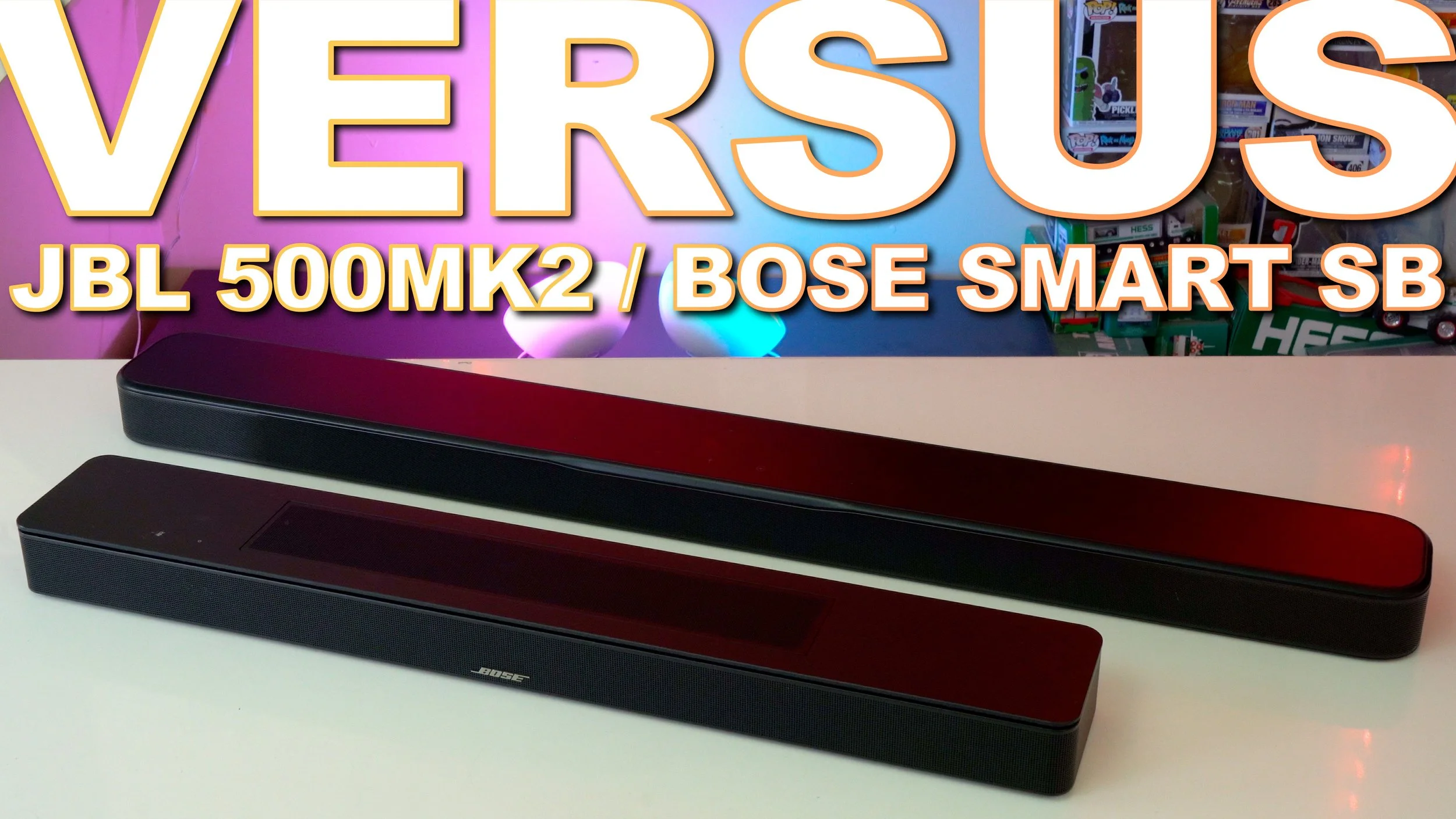
Now when it comes to the size of these soundbars, they’re actually all pretty compact and they’re super easy to place in your home theater set up. However the Sonos Ray is a little smaller. The Sonos Ray has a length of 22 inches, a hight of 2 and 3 quarter inches and a depth of 3 and half inches. Where as the Sonos Beam Gen 2 is a little bigger coming at a length of 26 inches a height of 2 and 3 quarter inches and a width of 4 inches. And then theres the Bose Smart Soundbar which has a length of 27 and a half inches, but its more low profile with a hight of 2.2 inches and a width of 4 inches.
Overall, all of these soundbars are compact and they’re easy to place and they are all good options for wall mounting cause they are all light weight and they all plug in via a double barrel AC port so theres no external power brick that you have to worry about. The main problem is, none of these soundbars come included with a wall mounting kit cause they are all sold serpeatly. Which I feel is redicouls on both Sonos’s and Bose’s part cause most other companies include the wall mounting kit in the box.
Now when it comes to connectivity, like I mentioned earlier the Sonos Ray connects to your tv via an optical port where as these other two soundbars connect via an HDMI port. And in general you always want to connect your soundbar to your tv via an HDMI port cause this way you’re going to be able to take advantage of higher quality audio formats like Dolby Atmos… but also you’re going to be able to easily adjust the volume of your soundbar with your TV’s remote.
Where as with the Sonos Ray, since this soundbar connects to your tv via an optical port, you’re going to have to go through a separate setup process so that your remote can adjust the volume on this soundbar. And depending on your tv’s remote, it may or may not work. Personally I think that it was a huge mistake that sonos didn’t add an HDMI port to the Sonos Ray, but they did add an ethernet port.
However all of these soundbars do have wifi so you can always stream music to them if you’re on the same network… but more importantly all of these soundbars have an app. So you can more easily adjust your sound which I feel is very important these days cause everything just has different mixing. But personally im not the biggest fan of Sonos’s app cause its very cluttered where as Bose’s app is a lot simpler to use. But overall im very impressed that the Sonos Ray has an app, period cause a lot of other soundbars in this price range dont have an app.
But either all of that out of the way lets talk about sound. Regarding speaker set up, all of these soundbars are very different from one another. The Sonos Ray has dual frontward firing speakers, dual frontward firing tweeters and dual bass chambers with exhaust ports that shoot out the front. Where as the Sonos Beam gen 2 has a single frontward firing tweeter and a total of 4 speakers. 2 that shoot out the front and 2 that shoot out the sides. And it also has a total of 3 passive radiators. 2 that shoot out the front and one that shoots out the back. And then theres the Bose Smart Soundbar which has a single frontward firing tweeter and a total of 4 speakers. Two that shoot out the sides and two that shoot upwards and it has dual beam chambers with exhaust ports that shoot out the back.
And the fact that the Bose smart soundbar has upwards firing speakers is a big deal cause this is the only soundbar here that has true dolby Atmos support. And what dolby atmos is, its an audio format that allows your sound to have height, instead of everything just being on a single plane. But now we’re going to jump into the sound test. All of these soundbars are playing at 70% volume with my preferred EQ settings and we’re going to be comparing them to the built in speakers found on the Sony Bravia 3, but those are going to be playing at max volume.
Sound test
So like you may have just heard, the Sony Bravia 3 actually performs pretty well. It has dual downward firing X balanced speakers which get decently loud, and thanks to the additional surface area, they produce a decent amount of bass. But with other entry level TV’s this built in speakers might not get as loud or their bass can become a rattling mess, but regardless, you’re almost always going to be much better off upgrading to a soundbar.
Now in this sound test, the Bravia 3 did a very good job of getting loud, distortion was not a problem and dialog was very present. But obviously, all of these soundbars managed to get significantly louder. But when it comes from a max volume stand point, the Bose Smart Soundbar is able to get louder than both of Sonos’s soundbars. Now I feel that both the Bose Smart Soundbar and the Sonos Beam Gen 2 are going to have no problem filling a bed room or a medium sized living room with sound. However the Sonos Ray is going to be better suited for a bed room or a small living room, this soundbar just don’t get super loud.
But when it comes from a sound quality standpoint, I feel that both of Sonos’s soundbars sound well balanced and they both have a decent amount of bass. But with the Bose Smart Soundbar, its stand out characteristic is that it sounds more open, thanks to the upwards firing speakers on this soundbar. So plainly said, either of these two larger soundbars are going to get louder and they Sonos Ray. Now the Sonos Ray sounds very similar to the Sonons Beam 2, it sounds balanced with a good amount of bass. But with the Bose Smart Soundbar, its going to get louder than the Beam 2 and its going to sound even more open thank to the upwards firing speakers.
But overall, I am very impressed by the Sonos Ray, it sounds good and it has app support. However this soundbar is going to be better suited for a bedroom or small living room. Now the optical port on this soundbar works fine… but I really wish that it had an HDMI port instead. But in general, I do think that it is worth upgrading to either the Sonos Beam 2 or the Bose Smart Soundbar especially if you plan on using your soundbar in your living room. The get louder and they have more bass. But also their HDMI ports is going to allow for easier set up and you’re going to be able to take advantage of higher quality audio formats. But defneitnly, if you plan on building out your soundbar, you do want to go with these larger soundbars specifically cause of the HDMI port.